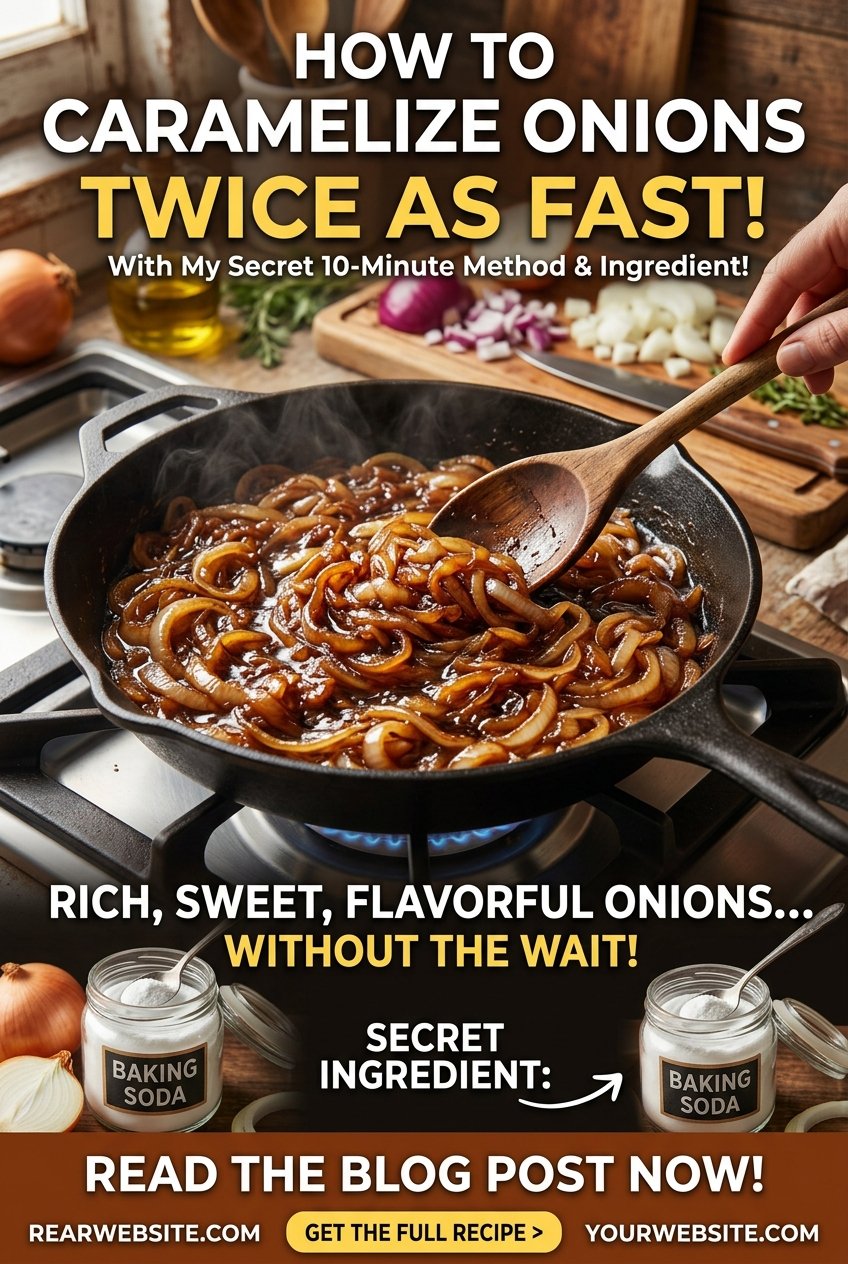
How to Caramelize Onions Twice as Fast (Secret Ingredient!)
Every home cook and professional chef knows the painful reality of caramelizing onions. You find a recipe that promises rich, sweet, jammy caramelized onions in “15 to 20 minutes.” You slice your onions, heat your skillet, drop them in, and 30 minutes later, you are still staring at pale, translucent strips that are nowhere near that deep mahogany color you crave. The truth is, authentic caramelization is a slow chemical process that typically takes 45 to 60 minutes of patient, active cooking. But what if you could hack this chemical process and slash your cooking time in half?
Enter the ultimate culinary science shortcut: baking soda onions. By adding a tiny, precise pinch of sodium bicarbonate (common baking soda) to your skillet, you can accelerate the browning process, unlock rich savory flavors, and achieve beautifully caramelized onions in a fraction of the time. This isn’t kitchen magic—it is pure organic chemistry.
In this comprehensive guide, we will break down the exact science of why this trick works, provide a foolproof step-by-step cooking guide, explore the culinary chemistry behind the Maillard reaction, and outline the critical scenarios where you should skip this technique to preserve the texture of your dishes. Let’s dive deep into the fascinating world of fast-tracked onion browning.
To understand the science of rapid browning, it is helpful to explore resources like the Exploratorium Science of Cooking, which details how basic chemical adjustments can completely transform the texture and flavor of our favorite ingredients.
—
The Science of Caramelization: Why Onions Take So Long
To appreciate why baking soda is such a game-changer, we must first understand what actually happens when we cook an onion. Slicing into an onion disrupts its cellular walls, releasing volatile sulfur compounds and setting off a chain of chemical transformations. When subjected to heat, those raw, pungent bulbs slowly morph into a sweet, savory culinary masterpiece.
What is Caramelization vs. The Maillard Reaction?
In casual kitchen conversation, we use the terms “caramelization” and “browning” interchangeably. However, in food science, these are two distinct chemical pathways that often occur simultaneously:
- Caramelization: This is the pyrolysis of pure carbohydrates (sugars) in the absence of nitrogen. It occurs at relatively high temperatures (typically starting around 310°F / 150°C for sucrose and fructose). As the heat breaks down the sugars, they volatilize, producing hundreds of new aromatic compounds and a rich, sweet, slightly bitter flavor profile.
- The Maillard Reaction: This is a reaction between amino acids (proteins) and reducing sugars. It starts at lower temperatures than pure caramelization (around 285°F / 140°C) and is responsible for the deep, complex, savory, and meaty flavors we associate with seared steaks, roasted coffee beans, and browned onion skins.
When you are browning onions, you are coaxing both of these reactions to occur. Because onions have a high water content (roughly 89% of an onion’s weight is water), these chemical reactions cannot begin in earnest until almost all the surface moisture has evaporated from the pan. Water boils at 212°F (100°C), a temperature far too low for both caramelization and the Maillard reaction to take place. This is why the traditional process takes so long: you must slowly evaporate the onion’s massive water reserves before browning can even begin.
The Role of Sugars and Amino Acids in Alliums
Onions are members of the Allium genus, which also includes garlic, shallots, leeks, and chives. They are packed with complex carbohydrates called fructans. As onions cook slowly, these long chains of fructans gradually break down into simpler, sweeter fructose and glucose molecules. This enzymatic and thermal breakdown of sugars, combined with the onion’s natural amino acids, provides the raw building blocks for both caramelization and the Maillard reaction. For a deeper scientific look at how heat breaks down food polymers, check out the educational resources provided by the Harvard University Science and Cooking program.
Why Temperature and Moisture Control are Crucial
Achieving perfect caramelization requires a delicate balancing act. If your heat is too high, the surface water evaporates too quickly, and the sugars burn before they can complexly caramelize, leaving you with bitter, charred onions. If your heat is too low, the water pools in the pan, boiling the onions instead of browning them. Traditional recipes require you to stand over the stove, constantly stirring and regulating the heat, to ensure the onions brown evenly without burning as the moisture slowly escapes.
—
The Secret Weapon: How Baking Soda Speeds Up Onion Browning
Now that we understand the chemical hurdles of browning onions, we can appreciate the genius of the baking soda hack. How can a common leavening agent cut your kitchen prep time in half?
Understanding pH Levels in Cooking
The pH scale measures how acidic or alkaline (basic) a substance is, ranging from 0 (highly acidic) to 14 (highly alkaline), with 7 being neutral. Raw onions are slightly acidic, typically resting at a pH of around 5.3 to 5.8.
Chemical reactions, including the Maillard reaction, are highly sensitive to their environmental pH. The Maillard reaction is significantly accelerated in alkaline (high pH) environments and severely retarded in acidic (low pH) environments. This is because alkaline conditions deprotonate the amino groups in proteins, making them much more nucleophilic and eager to react with the carbonyl groups of reducing sugars.
How Sodium Bicarbonate Alters the Onion’s Cell Walls
Adding baking soda (sodium bicarbonate), which is a mild base with a pH of around 8.1, immediately raises the pH of the cooking environment in your skillet. This has two profound physical and chemical effects on the onions:
- Accelerated Cell Wall Breakdown: The structural integrity of onion cell walls is maintained by pectin, a structural heteropolysaccharide. Pectin is highly soluble and degrades rapidly in alkaline environments. When you add baking soda, the alkaline environment accelerates the breakdown of these cellular walls. As a result, the onions soften, collapse, and release their internal moisture much faster than they would under neutral or acidic conditions.
- Rapid Water Evaporation: Because the cellular structure collapses so quickly, the onions dump their internal water reserves into the pan almost immediately. This water can then evaporate in a single, rapid burst, allowing the pan temperature to rise to the critical Maillard threshold much sooner.
Boosting the Maillard Reaction at a Chemical Level
By shifting the environment to an alkaline state, the baking soda allows the Maillard reaction to proceed at a lightning-fast pace. The amino acids and sugars react eagerly, skipping the long, drawn-out intermediate phases. What normally takes 40 minutes of slow cellular collapse and gradual browning can occur in 15 to 20 minutes. The result is a rapid transformation from pale white slices to a deep, golden-brown jam.
To explore the broader culinary applications of pH manipulation and Maillard reactions across different food categories, visit the American Chemical Society for comprehensive articles on food chemistry and everyday molecular interactions.
—
Step-by-Step Guide: How to Caramelize Onions with Baking Soda
While the chemical science behind this trick is complex, executing it in your kitchen is incredibly simple. However, because baking soda is highly effective, precision is absolutely key. Adding too much can ruin your dish. Follow this foolproof step-by-step guide to master the how to caramelize onions fast technique.
Ingredients and Equipment Needed
- Onions: 3 to 4 large yellow, white, or red onions (about 2 pounds raw). Yellow onions are highly recommended due to their balanced sugar and sulfur content.
- Fat: 2 tablespoons of unsalted butter, olive oil, or a combination of both. Butter adds rich dairy solids that enhance browning, while olive oil has a higher smoke point.
- Baking Soda: Exactly 1/4 teaspoon of sodium bicarbonate (baking soda). Do not confuse this with baking powder!
- Salt: 1/2 teaspoon of kosher salt (helps draw out moisture via osmosis).
- Liquid for Deglazing: 2 to 4 tablespoons of water, low-sodium broth, or dry white wine.
- Skillet: A large, heavy-bottomed pan. Stainless steel or cast iron is ideal for creating a flavorful fond (the browned bits stuck to the bottom of the pan).
Step 1: Prep and Slice Your Onions Correctly
Cut off the stem and root ends of your onions, peel them, and slice them in half from pole to pole (root to stem). Slice the onions thinly, about 1/8-inch to 1/4-inch thick. Slicing from pole to pole rather than across the equator helps the onions retain some structural integrity, which is especially important when using baking soda, as the alkaline environment will aggressively soften them.
Step 2: The Critical Ratio of Baking Soda to Onions
Place your skillet over medium heat and melt your fat. Add the sliced onions and toss them thoroughly to coat them in the oil or butter. Sprinkle the kosher salt evenly over the onions.
Now, measure your baking soda. The golden ratio is 1/8 teaspoon of baking soda per pound of raw onions. Since we are using 2 pounds of onions, we will add exactly 1/4 teaspoon. Sprinkle the baking soda evenly over the raw, sweating onions and stir vigorously to distribute it.
Step 3: Cooking and Moisture Evaporation
Within 2 to 3 minutes of adding the baking soda, you will notice a dramatic shift. The onions will turn a distinct pale yellow, release a large volume of liquid, and soften almost instantly. The kitchen will fill with a potent, sweet onion aroma. Keep the heat at medium, stirring every minute or two. The onions will quickly reduce in volume as the water evaporates rapidly.
Step 4: Monitoring the Fast-Track Browning Process
By minute 10 to 12, the water should be completely evaporated, and the onions will begin to brown rapidly. Keep a close eye on the pan at this stage, as the accelerated Maillard reaction can quickly cross the line into burning. Reduce the heat to medium-low if necessary.
As a rich, brown glaze (fond) develops on the bottom of the pan, add a tablespoon of water or wine to deglaze, scraping up those delicious caramelized bits with a wooden spoon and stirring them back into the onions. Repeat this deglazing process once or twice until your onions are deeply browned, jammy, and sweet. This should take a total of 15 to 20 minutes from start to finish!
—
The Golden Rules: When to Use the Baking Soda Hack
Because baking soda alters both the chemical rate of browning and the physical structure of the onion, this culinary shortcut is brilliant for specific recipes, but less suited for others. Let’s look at the absolute best scenarios to deploy this time-saving trick.
Rich French Onion Soup
French Onion Soup is the ultimate test of patience, traditionally requiring you to stand over a stove browning pounds of onions for up to an hour. Using the baking soda onions hack is an absolute lifesaver here. Because the soup is simmered for hours in beef broth, any loss of physical onion texture is actually a benefit, helping the onions melt seamlessly into a rich, cohesive broth. The intense savory depth created by the rapid Maillard reaction provides an incredible flavor base for the soup.
Savory Dips and Spreads
Whether you are making a classic caramelized onion dip with sour cream and cream cheese, or a gourmet bacon and onion jam, you want the onions to be as soft, sweet, and spreadable as possible. The fast-track baking soda method breaks down the onion’s cell walls completely, resulting in a luxurious, melt-in-your-mouth texture that blends perfectly into dips without leaving stringy, chewy chunks behind.
Blended Sauces and Gravies
If you are preparing a smooth gravy, a rich Indian curry base (such as a masala), or a caramelized onion cream sauce, you will be blending the onions anyway. Utilizing sodium bicarbonate to brown the onions in 15 minutes allows you to build deep flavor foundations quickly without wasting precious time standing over the stove.
Burger Toppings and Jams
For the ultimate smash burger or gourmet slider, a dollop of sweet, jammy caramelized onions elevates the dish to restaurant quality. The rapid softening effect of baking soda yields a jam-like consistency that clings perfectly to melted cheese and beef patties, ensuring you don’t pull long, hot stringy onions out of your burger with every bite.
—
Crucial Warnings: When You Must Skip This Time-Saving Trick
While the chemical transformation of onions with baking soda is highly efficient, it is not a universal culinary panacea. The very chemical reactions that make this trick work so well can also ruin certain dishes if applied incorrectly. Here is when you should leave the baking soda in the pantry.
The Texture Trap: Avoiding Mushy Onions
As discussed, sodium bicarbonate aggressively breaks down pectin, the structural glue holding onion cells together. If your goal is to have caramelized onions that still retain some bite, chew, or distinct physical structure, do not use baking soda. The accelerated breakdown will render the onions incredibly soft, mushy, and almost puree-like. For salads, rustic tarts, pizza toppings, or galettes where visual structure and texture are important, stick to the traditional slow-browning method.
The Metallic Aftertaste Risk: Why Less is More
Baking soda is a chemical salt. If you use too much of it, it will not fully react with the acids in the onions, leaving behind unreacted sodium carbonate. This manifests as a highly unpleasant, bitter, soapy, or metallic taste in your mouth. If you do not have a scale or precise measuring spoons, it is always safer to err on the side of using less baking soda rather than more. A tiny pinch is all it takes to shift the pH; dumping it in by eye is a recipe for a ruined meal.
Dishes Where Onion Texture Matters
In dishes like fajitas, stir-fries, or French-style tarts, the structural integrity of the onion is part of the eating experience. You want the onions to be sweet, yes, but you also want them to hold their shape and offer a pleasant textural contrast to the meat or pastry. In these cases, accelerating the cooking process with baking soda will leave you with an unappealing, watery mash rather than beautiful, distinct, caramelized ribbons.
—
Traditional vs. Accelerated Caramelization: A Head-to-Head Comparison
To help you decide which method is best for your specific culinary needs, let’s compare traditional caramelization with the accelerated baking soda method across several key categories.
| Feature | Traditional Method (Low & Slow) | Accelerated Method (With Baking Soda) |
|---|---|---|
| Cooking Time | 45 to 60 minutes | 15 to 20 minutes |
| Primary Chemical Driver | Slow pyrolysis of sugars & standard Maillard reaction | Accelerated Maillard reaction due to alkaline pH |
| Texture of Finished Onions | Tender but distinct ribbons with a slight chew | Soft, jammy, meltingly tender, almost pureed |
| Flavor Profile | Deep, clean, intensely sweet and complex | Rich, deeply savory, sweet, with a hint of earthy depth |
| Risk of Ruining Dish | Low (primarily risk of burning if neglected) | Medium (risk of soapy taste if over-measured) |
| Best Applications | Pizzas, tarts, salads, stir-fries, side dishes | Soups, dips, gravies, sauces, burger toppings |
Flavor Profile: Deep Sweetness vs. Rapid Richness
While both methods yield delicious results, discerning palates may notice subtle flavor differences. Traditional caramelized onions develop a clean, bright sweetness because the sugars break down slowly and naturally over time.
The baking soda method, by contrast, heavily favors the savory Maillard reaction. This results in a deeper, slightly more savory, almost “meaty” flavor profile. For savory applications like gravy or French onion soup, this extra savory boost is a major advantage. However, for sweet pastry applications, the traditional method’s pure sugar sweetness may be preferred.
Texture Analysis: Soft Jam vs. Tender Strips
The physical breakdown of pectin means that baking soda onions will always be softer than their traditionally cooked counterparts. If you are aiming for a luxurious, spreadable jam, the accelerated method is superior. If you want individual, glossy strands of onion to drape over a steak or scatter across a flatbread, the traditional method remains the gold standard.
Time and Energy Consumption Comparison
From an efficiency standpoint, the baking soda hack is a clear winner. It reduces active kitchen time by up to 60%, saving both your energy and your gas or electricity. If you are rushing to get a flavorful dinner on the table on a busy weeknight, this hack transforms caramelized onions from a weekend luxury into an easy weeknight staple.
—
Troubleshooting Common Mistakes When Using Baking Soda on Onions
Because this method relies on precise kitchen chemistry, minor mistakes can sometimes occur. Here is how to diagnose and easily fix common issues when browning onions with baking soda.
What to Do If You Added Too Much Baking Soda
If you accidentally slipped and poured too much baking soda into the pan, you will notice the onions turning a bright, neon yellow and taking on a soapy, slippery texture. To neutralize the excess alkaline base, you need to introduce an acid to bring the pH level back down to neutral.
The Fix: Squeeze a teaspoon of fresh lemon juice or add a splash of white wine vinegar or apple cider vinegar to the pan. The acid will react with the excess sodium bicarbonate, neutralizing the soapy taste and stabilizing the remaining pectin structure. Be careful not to add too much acid, or you will halt the browning process entirely!
Fixing Bitter or Off-Flavors
If your accelerated onions taste bitter, it is usually due to one of two things: minor burning or unreacted chemical salts.
The Fix: To mask minor bitter notes and balance the flavor profile, stir in a tiny splash of maple syrup, brown sugar, or balsamic vinegar at the very end of cooking. The sweetness and acidity of these ingredients will mask any chemical off-flavors and round out the savory depth of the onions.
Preventing Burning in Accelerated Browning
Because baking soda accelerates the Maillard reaction so aggressively, the line between beautifully browned and burnt can disappear in a matter of seconds once the water has evaporated.
The Fix: Always keep a glass of water right next to your stove. The moment you see the bottom of the pan getting too dark or the onions beginning to scorch, splash in 2 tablespoons of water. This immediately lowers the temperature of the pan surface, dissolves the burnt sugars, and allows you to scrape up the fond and safely redistribute the heat.
—
Frequently Asked Questions (FAQs)
Can I use baking powder instead of baking soda?
No, you cannot. Baking powder contains sodium bicarbonate mixed with an dry acidifying agent (like cream of tartar) and starch. Using baking powder will not raise the pH of your onions effectively, and the added starches can scorch in your skillet, creating a burnt, sticky mess. Always use pure baking soda (sodium bicarbonate).
Does this trick work with red onions or sweet onions?
Yes, the baking soda trick works wonderfully with all varieties of onions, including red, yellow, white, and sweet onions (like Vidalias). Sweet onions already have a high sugar-to-starch ratio, so they will caramelize even faster, but keep an eye on them as they are even more prone to scorching due to their elevated sugar content.
Will my caramelized onions taste soapy?
Not if you follow the correct ratio! As long as you stick to the golden rule of 1/8 teaspoon of baking soda per pound of raw onions, the sodium bicarbonate will fully react with the natural acids in the onions, leaving zero chemical or soapy residue behind. Soapy flavors only occur when the baking soda is overused.
How long do baking soda caramelized onions keep in the fridge?
You can store your quick caramelized onions in an airtight container in the refrigerator for up to 5 to 7 days. Because they are highly broken down and jammy, they also freeze exceptionally well. You can spoon them into an ice cube tray, freeze them solid, and then transfer the onion cubes to a freezer bag for up to 3 months. Drop a cube directly into soups, sauces, or pan gravies whenever you need an instant boost of savory flavor!
Does this trick work for caramelizing other vegetables?
Yes! The exact same scientific principles apply to other vegetables that undergo the Maillard reaction, such as carrots, celery, or mushrooms. Adding a tiny pinch of baking soda to finely minced mirepoix (onion, carrot, celery) will help you build a deeply savory flavor base for soups, stews, and braises in a fraction of the traditional time.
Do I need to use more oil when using baking soda?
No, you do not need extra fat. In fact, because the onions collapse and release their water so quickly, you may actually find you need slightly less fat than usual to keep them from sticking. If the pan ever looks dry, simply add a splash of water rather than more oil to keep the cooking process smooth and low in excess fat.
—
Conclusion & Final Culinary Takeaway
Cooking is an art, but baking and advanced culinary techniques are pure science. Understanding how minor chemical adjustments can dramatically alter our food is what separates average home cooks from world-class chefs. The baking soda onions hack is a premier example of how molecular gastronomy can be practically applied in any home kitchen to save time, reduce effort, and deliver incredible flavor.
By raising the pH of your skillet with a simple pinch of sodium bicarbonate, you fast-track the breakdown of tough onion cell walls and supercharge the savory Maillard reaction. While you must skip this trick when cooking dishes that require firm, structurally intact onion rings, it is the ultimate game-changer for French onion soups, savory dips, rich gravies, and delicious burger toppings.
The next time you are planning a meal that calls for the deep, savory sweetness of caramelized onions, don’t dread the hour-long commitment. Grab your baking soda, measure out a precise pinch, and unlock restaurant-quality flavor in half the time. Happy cooking!